
 Industries
 Products
 Services
 Solutions
Blog | Why Real-Time DER Control is Essential
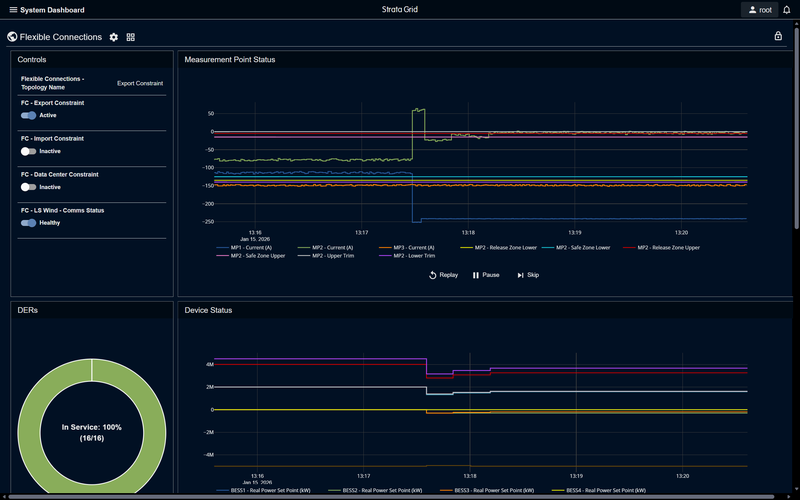
MEPPI DERMS is orchestrating energy - bringing the intelligence of innovative power grid analytics to real time.
Distributed Energy Resource (DER) management is becoming a cornerstone of modern grid operations. As utilities integrate more renewable and distributed assets, the ability to monitor and control these resources becomes critical for reliability, efficiency, and safety. While many DER Management Systems (DERMS) offer control capabilities, the timescale of control (how quickly measurements are processed, and actions are executed) can make or break system performance. With DER penetration and its grid impacts accelerating each year, control systems that operate in real time (~1 second response) are essential to maintaining a safe distribution system.
This blog explores the effective differences between using a scheduled control approach and a real-time control approach, and how MEPPI’s Strata Grid leverages both real-time and scheduled control to maximize DER value.
Scheduled Control
Scheduled control is defined as a form of control where a pre-defined schedule of setpoints is issued to a DER. These are often 15-minute, 30-minute, or hourly schedules, though in some situations the resolution can be as low as 5 or 1 minute.
Advantages
The primary benefit of scheduled control is that it is simple and straightforward, providing several benefits:
Disadvantages
With the simplicity afforded by scheduled control come associated disadvantages:
- Inaccuracy in results due to reliance on forecasted states
- Due to forecast inaccuracy, control algorithms must incorporate extra bandwidth buffer to protect grid equipment from violating rated capacity.
- Slow response to grid events as fastest possible response is one resolution step (~15 minutes) if it is responsive at all.
- This poses a danger to equipment which may see ratings violations for extended periods.
- Inability to coordinate with distribution automation or protection schemes.
DERMS Use Cases
As mentioned above, certain use cases rely on scheduled control to effectively operate.
OPF is the execution of a converging mathematical optimization against the physical model of a power system, with the objective of minimizing or maximizing one or more properties of the power system (e.g., minimizing losses). It requires a complete state of the system (load values at every node), and it also requires several minutes to execute. OPF execution time is unbounded and subject to non-convergence – particularly with poor data quality. In most cases, OPF relies on assumptions and extrapolations in its datasets to generate any answer at all.
Dynamic operating envelopes (DOEs) are a method by which a DER may have its allowable operating range controlled dynamically throughout the day. Using analytics like OPF, DOEs can coordinate operating ranges across a wide array of DER in a region. However, reliance on these OPF-style converging network model analysis algorithms means that this type of envelope calculation is subject to the same temporal restrictions as OPF thus limiting it to the domain of scheduled control.
Residential behind-the-meter (BTM) demand response is a key instrument in alleviating peak load at distribution. Due to its reliance on residential customer participation however, demand reduction events often must be scheduled well in advance. Some BESS-driven programs have near real-time response, but most programs (e.g., thermostat programs) require scheduled control.
Real-Time Control
Real-time control operates under the premise that control actions are event-driven, occurring in the scale of seconds or milliseconds rather than minutes in reaction to deviations in grid conditions. When voltage or thermal limits are breached, every second counts. Delays increase equipment stress, risk outages, and force rushed decisions.
Advantages
Real-time control has advantages over scheduled control in any case where it can be effectively applied:
- Higher accuracy in response due to tight coordination between high-resolution field measurements and DER response.
Disadvantages:
Any control algorithm responding in a real-time, second-by-second basis also experiences limitations due to the timeframe:
DERMS Use Cases
Any control scheme benefitting from fast response time has advantages using real-time control:
Flexible Interconnection is a means of interconnecting medium-scale DER such as PV and controllable data center loads to the distribution grid under a scheme allowing the utility to reduce their output if required by grid conditions (e.g., to prevent thermal overload at a transformer). While this use case can be accomplished using scheduled control methods, these methods suffer from lack of accuracy due to their reliance on forecasts. Only in real time can flexible interconnections maximize grid capacity and DER output.
DOE enforcement requires real-time control to maintain a DER within its boundaries for a given envelope. While the envelope calculation may be driven by scheduled control methods, effective enforcement requires real-time control – either by a DERMS or at the smart inverter level.
MEPPI Advantage
MEPPI DERMS is the market leader in real-time control DERMS applications such as flexible interconnections. MEPPI DERMS’ real-time control algorithms are grid-aware, making use of innovative power system linearization to bring the intelligence of power flow to the fastest-acting DERMS on the market.
MEPPI DERMS executes grid-aware calculations and control actions in 500–750 milliseconds, enabled by patented algorithms and a layered approach that balances speed with accuracy. This allows utilities to tighten operating margins and unlock more capacity safely.
With 18 years of experience deploying real-time DERMS control algorithms, MEPPI understands the complexities and opportunities of managing DER at scale and at lightning speed.
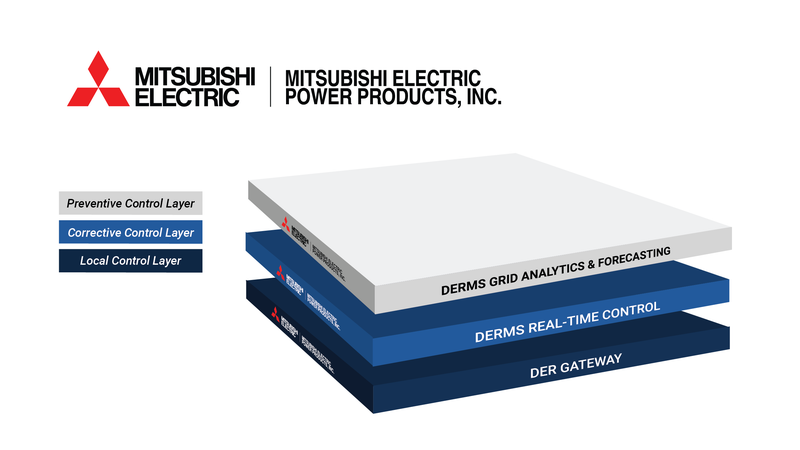
MEPPI DERMS uses a layered approach (scheduled and real-time control techniques) for the best-of-both-worlds offering.